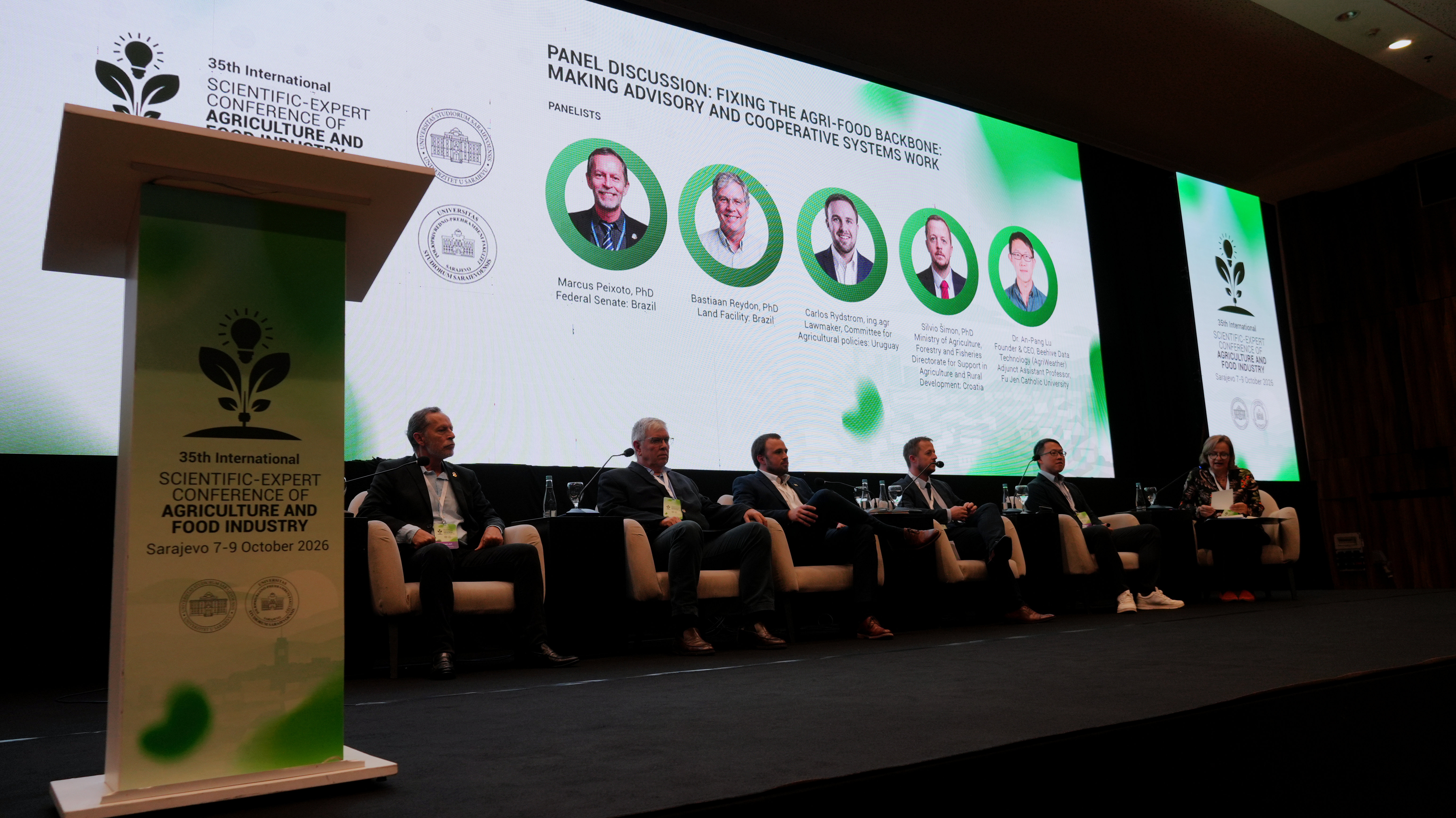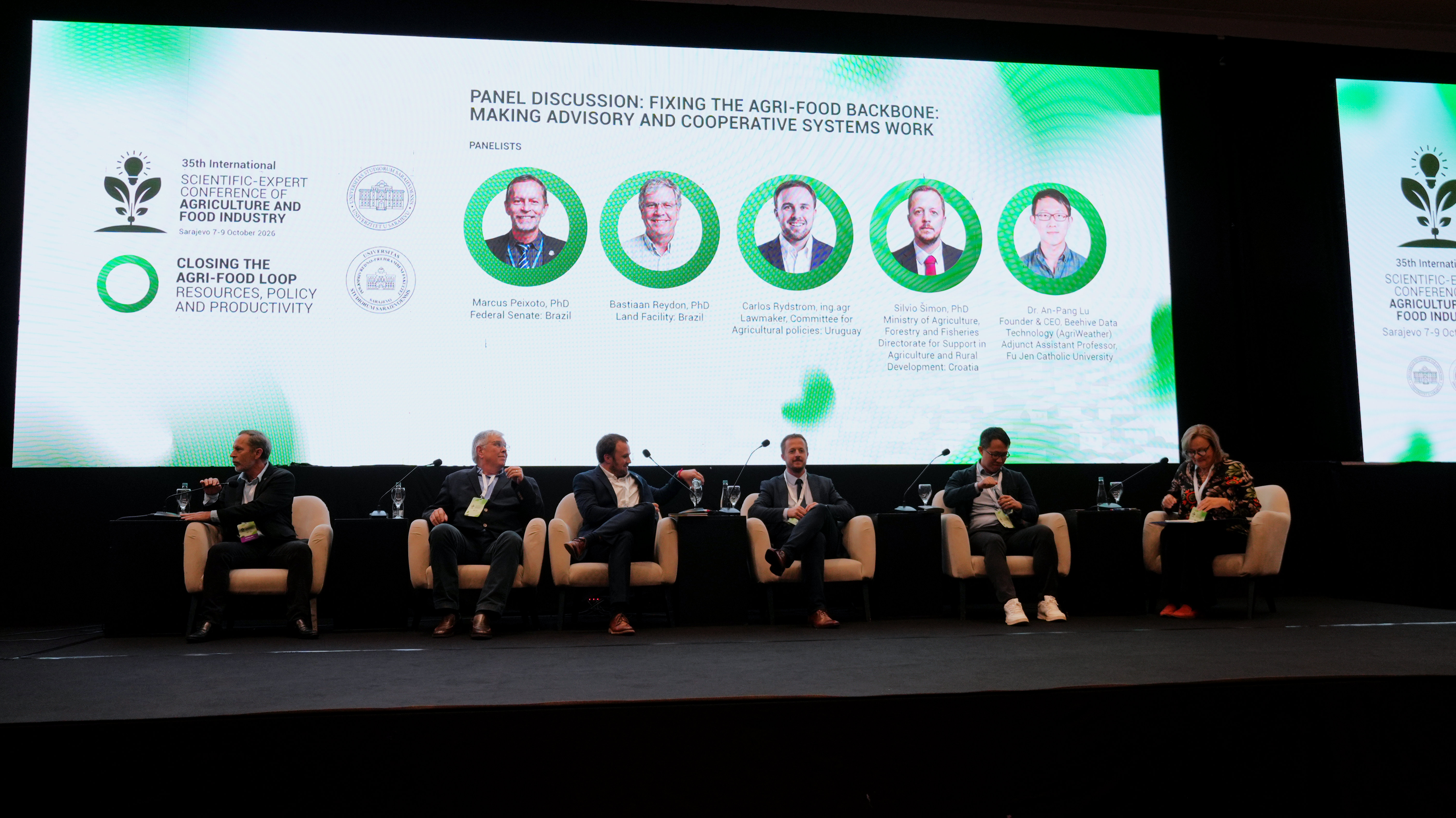


The guiding idea of the panel discussion, "Fixing the
Agri-Food Backbone: Making Advisory and Cooperative Systems Work," was
that sustainable agriculture starts with strengthening trust in local
communities and connecting producers, cooperatives, researchers, advisory
services, the business community, and institutions.
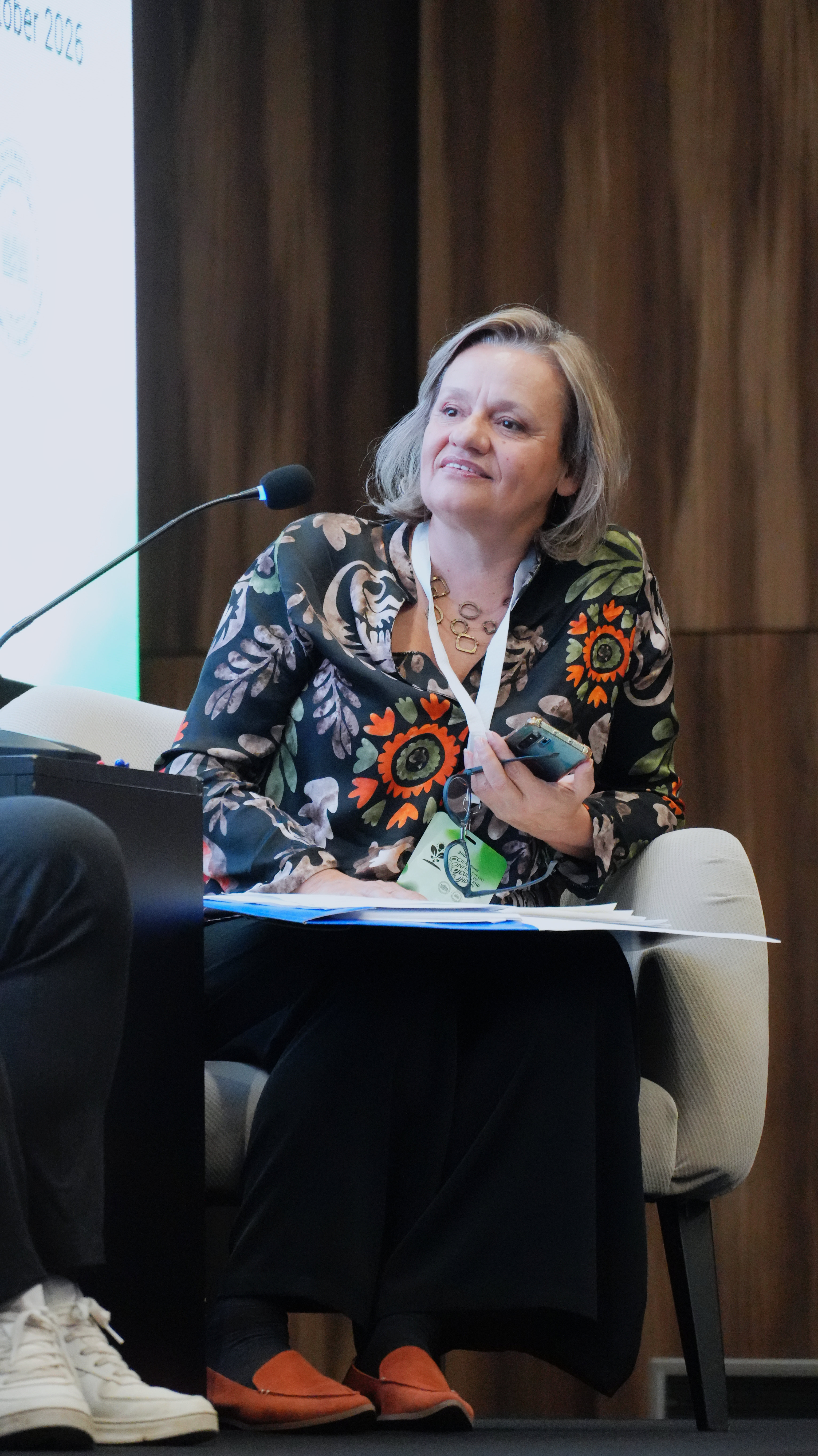
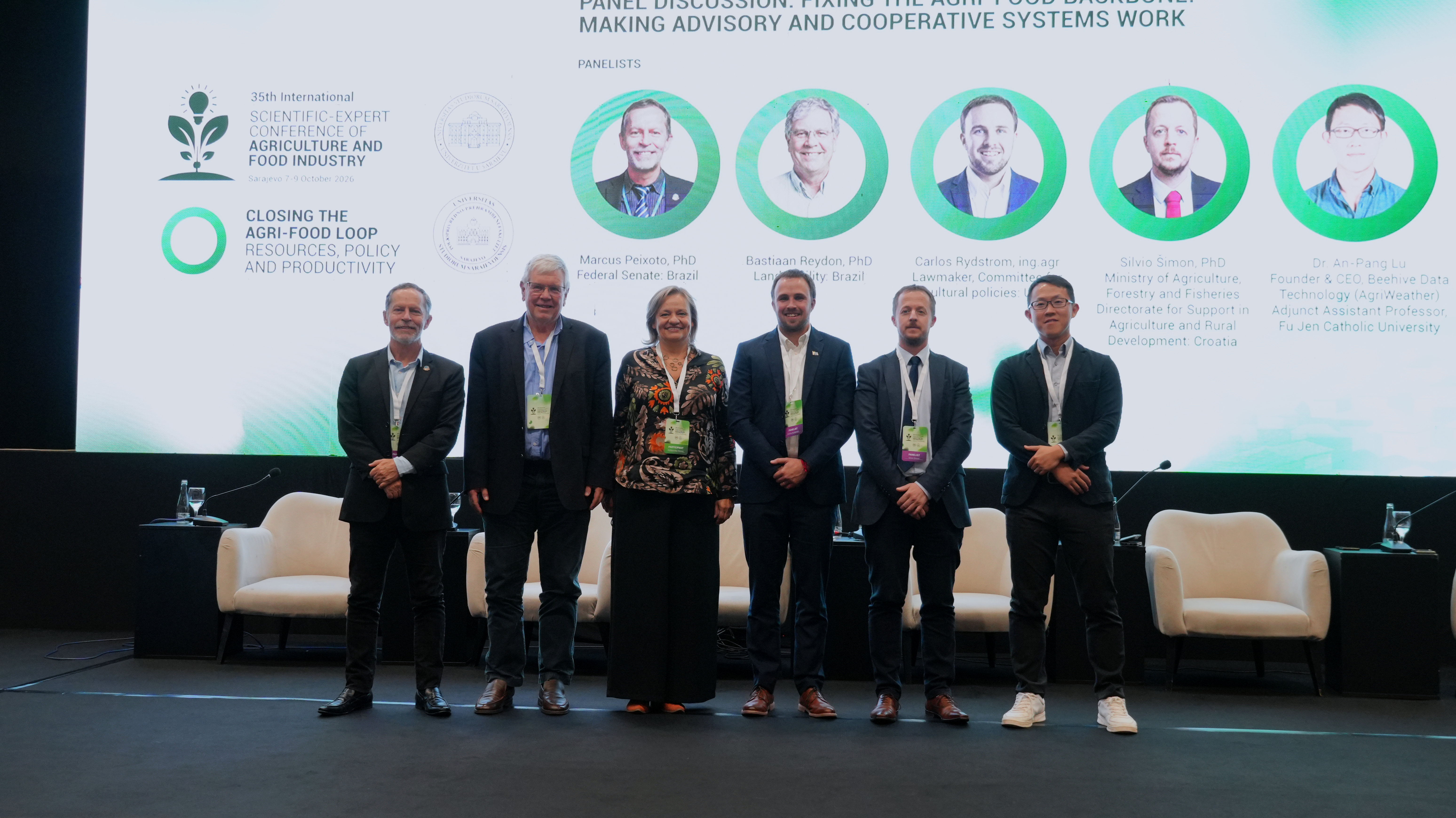
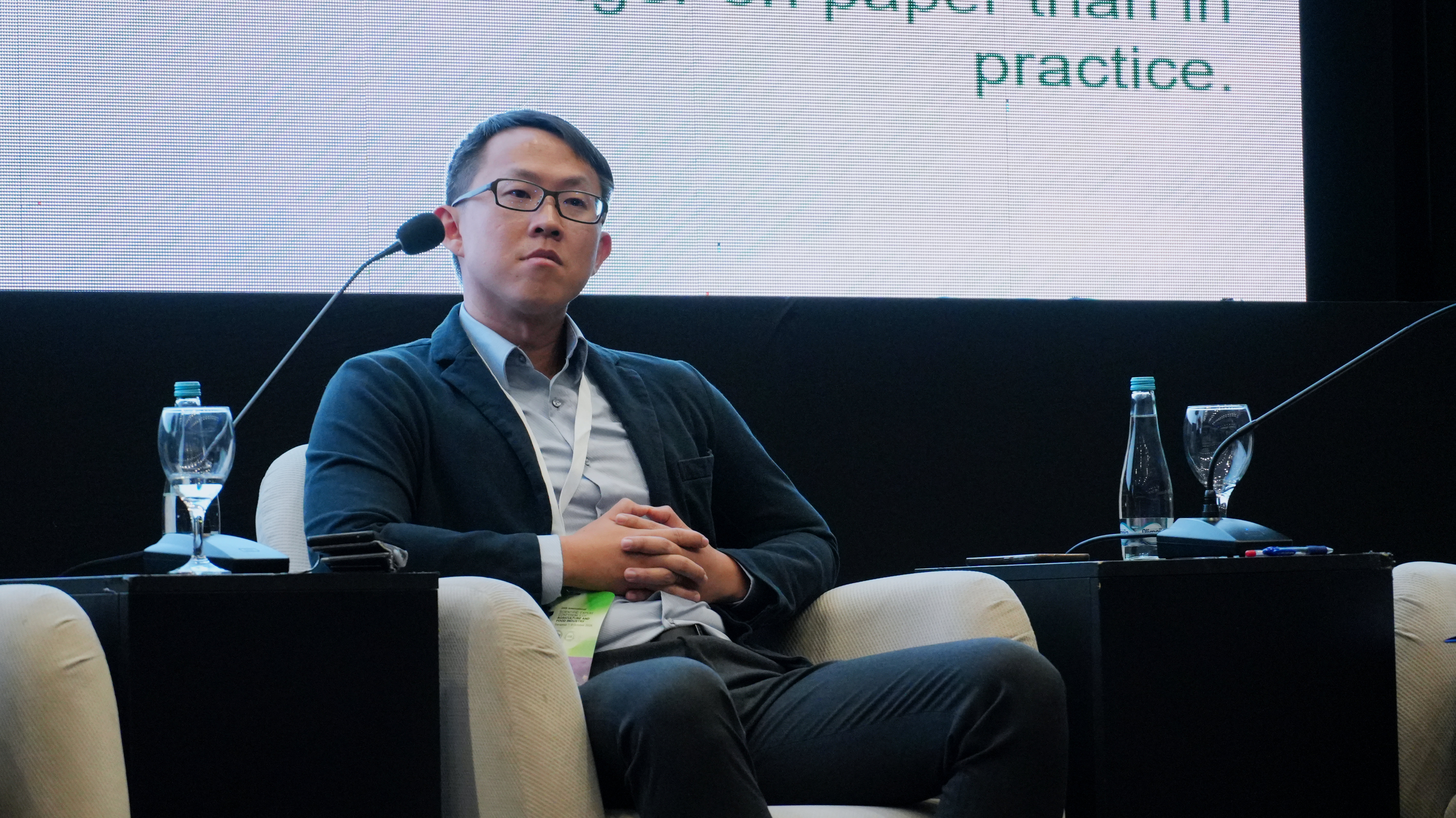
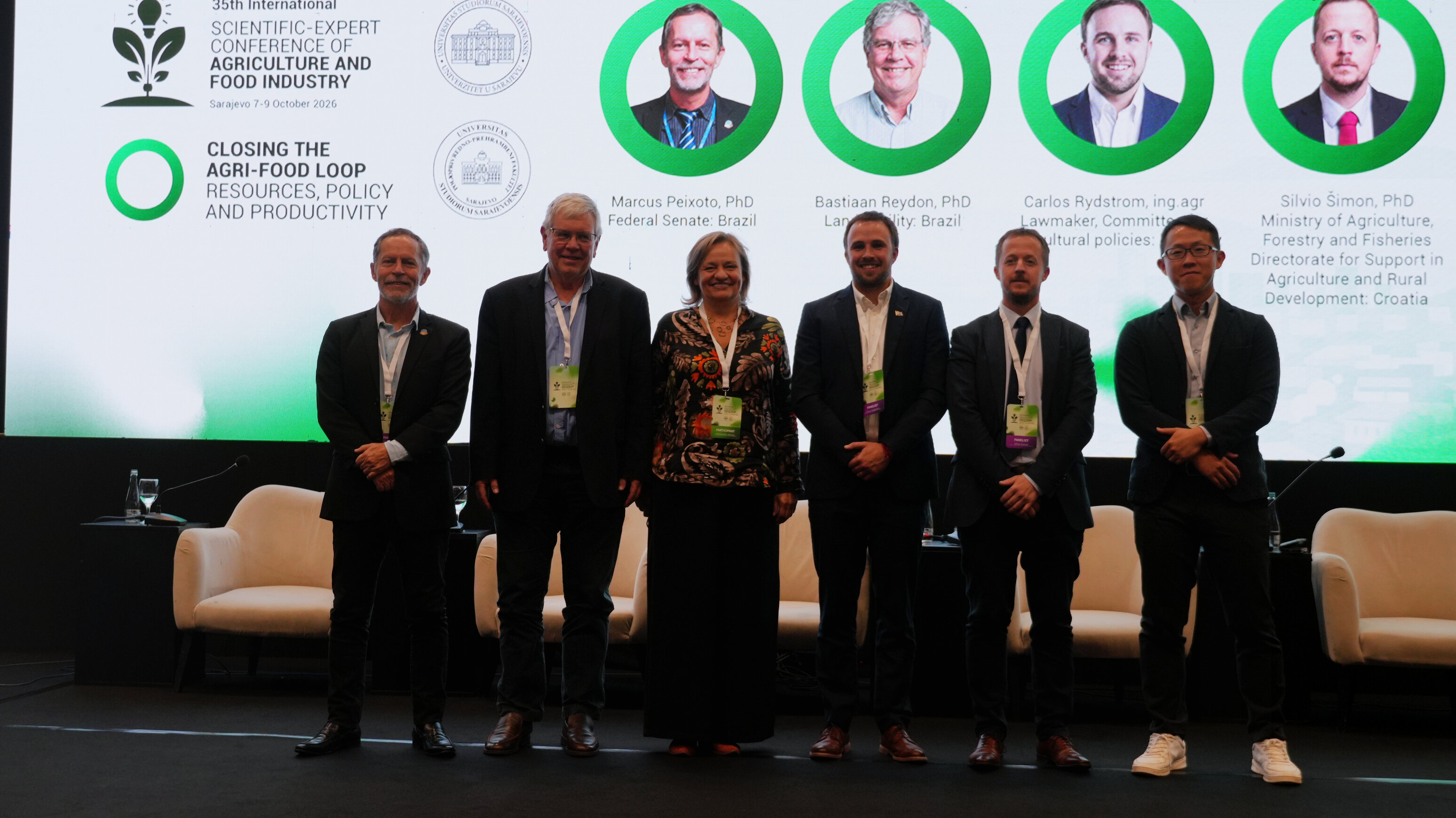
The facilitator, Prof. Aleksandra Nikolić, PhD, shaped a
stimulating environment with her excellent choice of questions and encouraged
an exchange of diverse experiences among international experts from five
countries on three continents:
•
Prof. Bastiaan P. Reydon, PhD, Economic Advisor for
Land Reform Settlement Cooperatives, Brazil
•
Markus Peixoto, Ph.D., President of the Brazilian
Society of Rural Economics, Administration and Sociology, Brazil
•
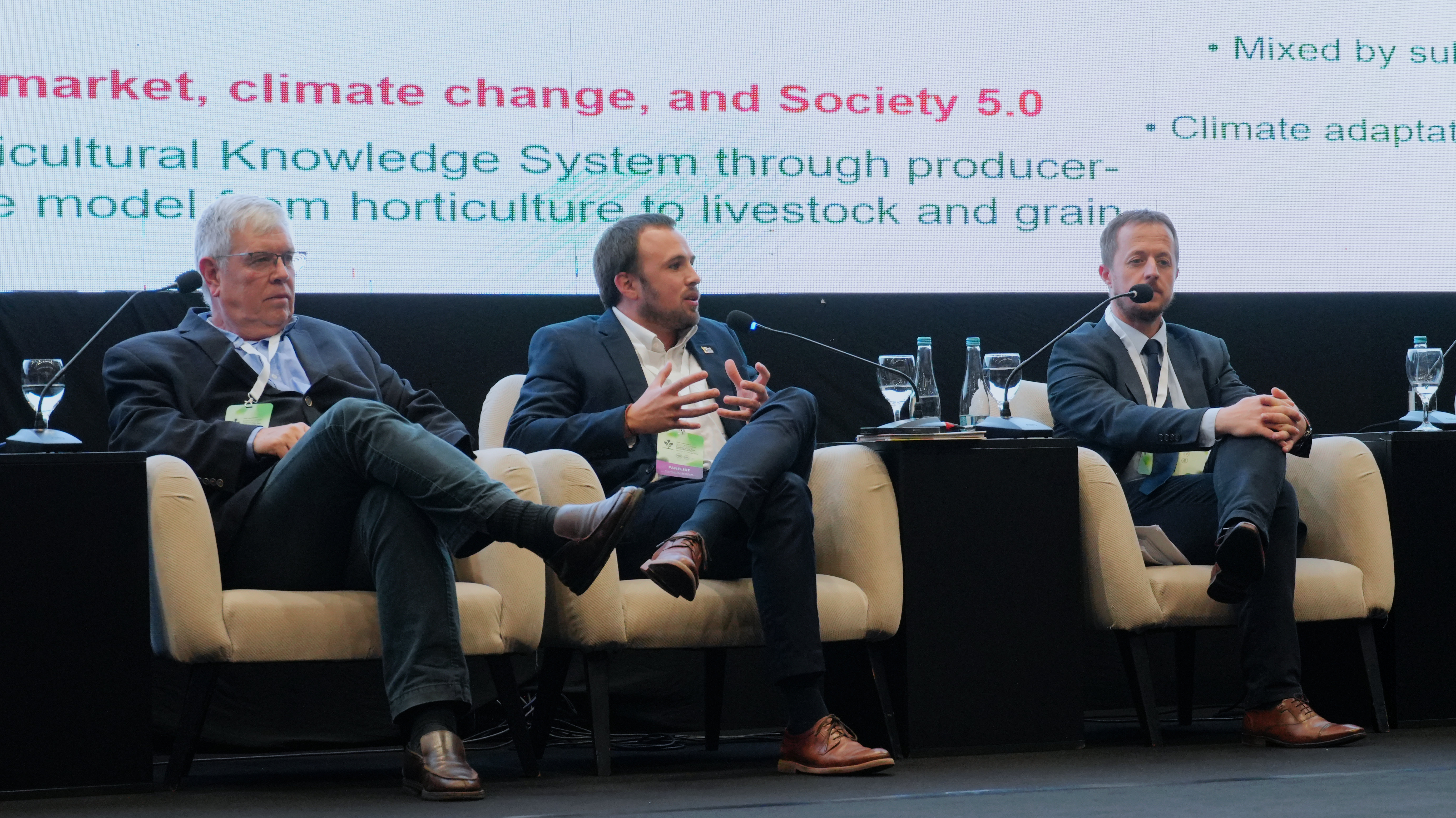
Carlos Rydrstorm, National System for Innovation and
Rural Development (SINDER), Uruguay
•
Riddler LU, professor, founder and CEO of Beehive Data
Technology, Taiwan
•
Silvio Šimon, Ph.D., Head of the Sector for the
Implementation of Rural Development Measures and Interventions, Ministry of
Agriculture, Forestry and Fisheries of the Republic of Croatia
Although experiences and agribusiness systems differ, the
panelists agreed on several key areas that will shape the future of food
production, distribution, and consumption across the planet and in every local
community.
Trust, cooperation, respect for local needs, professional
management driven by modern technologies, effective exchange of experience, and
the ability to co-create innovation are key to further progress. The discussion
also stressed the importance of encouraging and including young people and
women in decision-making structures at all levels: from farms and cooperatives,
through the institutions that support the sector, to the administrations that
create public policy.
Sustainability must become part of how we govern. Protecting
land, water, and biodiversity, and adapting to climate change, require
long-term thinking and solutions tailored to producers' real needs.
Cooperatives are more than joint marketing of products or
organizations that supply inputs. When professionally managed and built on
trust, they can connect producers with the market, turn farmers into
entrepreneurs who understand the needs of all business actors, develop new
products, create added value, and strengthen the resilience of rural
communities.
The digital transformation of the agri-food sector has begun
and is unfolding in different ways, but it always rests on connecting people
and knowledge. This allows us to optimize processes and anticipate needs, making
the sector's contribution visible in quality of life, environmental protection,
and population health. Artificial intelligence, IoT, modern machinery, and
digital tools can accelerate modernization, but their success depends on access
to expert support, relevant knowledge, and farmers' active involvement in
developing solutions. Advisory services must become the epicenter of the new
digital system: enabling farmers to take part in the transfer of knowledge and
practice, and helping to shape new forms of research and development, such as
citizen science and "living labs."
Young people must drive change, not just inherit existing
systems. Their competencies and readiness to apply new technologies offer an
opportunity for generational renewal in agriculture and for modernizing
cooperatives.
These messages connect strongly with the vision of Society
5.0, a society in which digital technologies serve people, communities, and
sustainable development. In this approach, innovation is not an end in itself
but a means of improving quality of life, competitiveness, and responsible
management of natural resources.
AGRICONFERENCE 2026 shows why interdisciplinary dialogue and
international exchange of experience are essential for transforming food
systems. The future will not be shaped by isolated actors, but by those who can
connect science, practice, technology, the market, and social responsibility.
The future of
sustainable agriculture is built on cooperation, and innovation begins when
knowledge becomes a shared strength.